
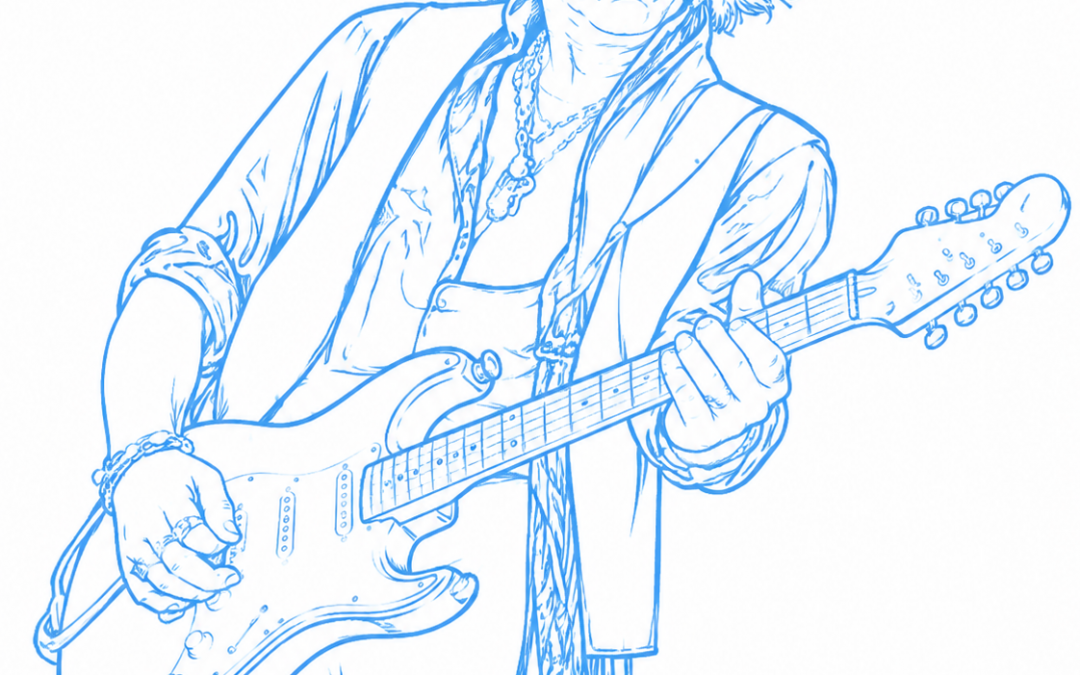
Some guitarists can be recognized before you even identify the song. Their sound does not come from a particular guitar, a specific amplifier or a fixed combination of effects. It is the result of years of experimentation, technical decisions and a personal way of understanding the instrument.
Joe Perry belongs to that kind of guitarist.
Throughout his career, he has developed a distinctive guitar voice shaped by direct riffs, expressive playing, organic character and an unconventional relationship with his gear. His sound has never depended on a single formula. Instead, it has emerged from an ongoing search: trying different instruments, combining setups and finding new ways to turn a musical idea into something unmistakable.
Tone Does Not Come from a Single Piece of Gear
When discussing a guitarist’s tone, attention often focuses on the guitar model, pickups or amplifier. However, the final sound comes from the interaction of many different elements.
Pick attack, dynamics, tuning, component selection, instrument setup and amplifier response all belong to the same signal chain.
In Joe Perry’s case, that chain has never remained completely fixed. His approach demonstrates that tone should not be understood as a closed setup, but as a language that develops alongside the musician.
Perry has used guitars with very different characteristics because each instrument provides a particular response. Some offer more body and sustain, while others deliver a sharper attack, different pickup combinations or additional expressive possibilities through a vibrato system.
Although he has often been drawn to the powerful body of Les Paul-style guitars, he has also made extensive use of Stratocaster-style instruments for their tonal variety and the possibilities offered by the vibrato arm.
The Guitar as a Palette of Colours
One of the most interesting aspects of Joe Perry’s approach to sound is the idea that one guitar does not have to meet every musical need.
Each instrument can provide a different colour.
A guitar equipped with humbuckers can deliver density, power and a thicker response. A single-coil configuration can offer definition, brightness and greater contrast between pickup positions. A vibrato system introduces another dimension by allowing the guitarist to alter pitch and create movements that would be impossible with a fixed bridge.
Perry has described the vibrato as another colour in a guitarist’s sonic palette.
This perspective helps explain why his sound cannot be reduced to one guitar or one particular setup. His identity remains consistent, but the tools change according to the idea, context or feeling he wants to explore.
The instrument does not replace the musician’s personality. It expands it.
From the Stratocaster to the Character of the Les Paul
Joe Perry’s popular image is closely associated with Les Paul-style guitars. Their full sound, sustain and ability to produce powerful overdrive complement his approach to riffs and lead parts.
This type of instrument offers a heavier tonal foundation and makes it easier to achieve a strong distorted sound while keeping unwanted noise under control.
However, a significant part of Perry’s early recorded work involved Stratocaster-style guitars. This choice reveals a fundamental aspect of his working method: a willingness to use any tool that brings him closer to the sound he has in mind.
A Les Paul can provide depth and sonic weight. A Stratocaster can offer definition, tonal variety and movement. Neither instrument represents the entirety of his identity on its own.
Tone emerges when the guitarist understands what each instrument can offer and learns how to incorporate those qualities into a personal musical language.
Experimentation Before Formula
Developing a distinctive sound requires curiosity.
Over the decades, Joe Perry has played vintage guitars, custom models, straightforward instruments and configurations designed to meet specific creative or technical needs.
His relationship with guitars does not appear to be guided solely by value, brand or age. What matters is how an instrument responds in his hands and which ideas it can inspire.
During his early years, Perry frequently exchanged instruments whenever he encountered a guitar that caught his attention. This reflects an open and practical approach: try, compare and make decisions based on real playing experience.
That attitude also extends to amplifiers, pedals and hardware. A piece of equipment may become part of the sound during one period and then be replaced when another solution responds more effectively to a new requirement.
The search for the perfect tone is not a journey towards a permanent final destination. It is a sequence of decisions that helps the guitarist continue evolving.
A Sound Built on Response and Dynamics
Joe Perry’s tone is not defined only by gain or the thickness of his guitar sound. Much of its character comes from dynamic response.
A well-matched guitar and amplifier allow the sound to change according to pick attack, the guitar’s volume control and the way a note is sustained.
That responsiveness is especially important for a guitarist who builds much of his language around riffs. A riff needs weight, but it also needs space. It must retain enough definition for every accent, pause and rhythmic variation to remain clear.
Technology should support that interaction rather than conceal it.
For this reason, choosing professional equipment is not simply about looking for superior specifications. It is also about finding components that respond in a predictable, natural and musical way.
The Role of Hardware in a Guitarist’s Identity
Guitar hardware often receives less attention than pickups or amplifiers, but it directly influences the musician’s experience.
The bridge, vibrato system, saddles, tuning machines and string contact points affect factors such as:
- Tuning stability.
- Feel under the player’s hands.
- Sustain.
- Instrument response.
- Intonation accuracy.
- Freedom to use expressive techniques.
When a guitarist uses a vibrato system, the hardware is no longer a passive support structure. It becomes an expressive tool.
The vibrato arm can introduce subtle movement, extend the motion of a chord or alter a note much more dramatically. For that expressiveness to be useful, the system must respond sensitively and return reliably to a stable position.
Hardware selection therefore contributes not only to the sound, but also to the guitarist’s confidence. The more naturally the instrument responds, the less the musician needs to think about the mechanism and the more attention can be devoted to the music.
Tradition and Innovation Are Not Opposites
Joe Perry’s career also shows that respecting tradition does not mean rejecting progress.
Classic instruments remain relevant because they provide an aesthetic, feel and sonic personality that are difficult to replace. However, the needs of professional guitarists have continued to evolve.
Live environments are more demanding. Setups need to be more reliable. Musicians expect improved stability, accuracy and versatility without losing the emotional relationship they have with their instruments.
The most valuable innovation does not always involve completely transforming a guitar. In many cases, it means improving its functionality while respecting the qualities that make it special.
This approach to design allows a traditionally inspired instrument to meet contemporary needs without losing its original identity.
The Search for a Personal Sound
The most important lesson to take from Joe Perry’s evolution is not which guitar to buy or which amplifier to use.
It is the importance of building a personal relationship with the instrument.
An individual tone begins to emerge when the musician stops chasing other players’ setups and starts understanding how their own equipment responds to their playing style. From that point onwards, every change has a purpose: achieving greater clarity, improved control, a different feel or a new expressive possibility.
Gear matters, but not as a collection of objects. It matters as a system of tools serving a musical idea.
The Perfect Tone Is Always Evolving
After decades of performing, recording and experimenting, Joe Perry has continued to explore new guitars, amplifiers and technical solutions. His interest in equipment has remained connected to the search for different responses in the studio and on stage.
That lasting curiosity explains much of his musical identity.
The perfect tone is not necessarily a fixed sound that is discovered once and preserved forever. It may be the right sound for a particular song, performance or moment.
Finding it requires an understanding of tradition, but also a willingness to try something new.
Ultimately, innovation begins with precisely that sense of curiosity: imagining new possibilities and developing the tools needed to turn them into music.
Frequently Asked Questions About Joe Perry’s Guitar Sound
What does Joe Perry’s guitar tone sound like?
Joe Perry’s guitar tone is characterised by direct riffs, organic overdrive,
dynamic response and a combination of thick, powerful sounds with brighter,
more clearly defined tones.
What guitars does Joe Perry use?
Joe Perry has used a wide range of instruments throughout his career,
particularly Gibson Les Paul and Fender Stratocaster-style guitars, as well
as vintage instruments, customised guitars and other designs.
Why does Joe Perry use different guitars?
Each guitar provides a different response, feel and tonal personality.
Perry uses different instruments to explore new textures, types of attack,
levels of sustain and expressive possibilities.
How important is vibrato to Joe Perry’s guitar sound?
A vibrato system expands the expressive possibilities of the guitar by
enabling pitch variations, subtle movement and more dramatic effects.
Perry has described vibrato as another colour in a guitarist’s sonic palette.
How can a guitarist develop a personal tone?
Developing a personal tone requires understanding how the instrument
responds, experimenting with different setups and selecting hardware and
equipment according to the player’s technique and musical needs.